中文简体
中文简体

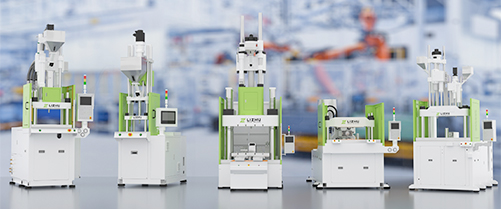


A vertical plastic moulding machine is an injection moulding system in which the clamping unit and injection unit are arranged along a vertical axis, making it the preferred solution for insert moulding, overmoulding, and precision small-part production. Unlike horizontal machines, the vertical orientation uses gravity to hold inserts in place, reduces floor space by up to 50 percent, and enables operators to load components into the open mould safely and efficiently. This guide covers how these machines work, which types exist, where they are used, and how to select the right model for your production line.
How a Vertical Plastic Moulding Machine Works
A vertical plastic moulding machine follows the same fundamental injection moulding cycle as a horizontal machine, but with all primary axes oriented vertically — the injection unit sits on top and the clamping system moves up and down. Understanding this cycle is essential for evaluating whether a vertical configuration suits your production requirements.
The production cycle of a vertical plastic injection moulding machine consists of six sequential phases:
- Insert Loading: The operator or robotic arm places metal inserts, electrical connectors, fabric, or other components into the lower (stationary) mould half. Gravity keeps these inserts seated securely — a critical advantage over horizontal configurations where inserts must be mechanically held.
- Mould Closing: The upper platen descends and clamps the mould shut with the required clamping force, typically measured in tonnes. Clamping force on vertical machines ranges from 5 tonnes for micro machines to over 1,000 tonnes for large industrial models.
- Injection: The injection unit, mounted vertically above the mould, pushes molten thermoplastic resin through the nozzle, runner system, and gate at pressures typically between 800 and 2,100 bar, filling the mould cavity.
- Packing and Holding: After the cavity is filled, pressure is maintained momentarily to compensate for material shrinkage as the plastic cools. This phase directly influences dimensional accuracy and surface quality.
- Cooling: The moulded part solidifies within the temperature-controlled mould. Cooling time — typically 60 to 80 percent of the total cycle time — is controlled through water channels embedded in the mould.
- Ejection: The upper platen rises, the mould opens, and ejector pins push the finished part out of the mould cavity. On rotary-table vertical machines, the operator simultaneously loads new inserts into the alternate station, dramatically increasing throughput.
The vertical arrangement creates a natural ergonomic advantage: the open mould faces upward and is at waist height, allowing operators to stand comfortably while loading inserts rather than bending sideways as required by horizontal machines.
Which Types of Vertical Plastic Moulding Machines Are Available
Vertical plastic moulding machines are available in four primary configurations, each designed for specific production volumes, part geometries, and levels of automation. Choosing the wrong type is one of the most costly mistakes a manufacturer can make.
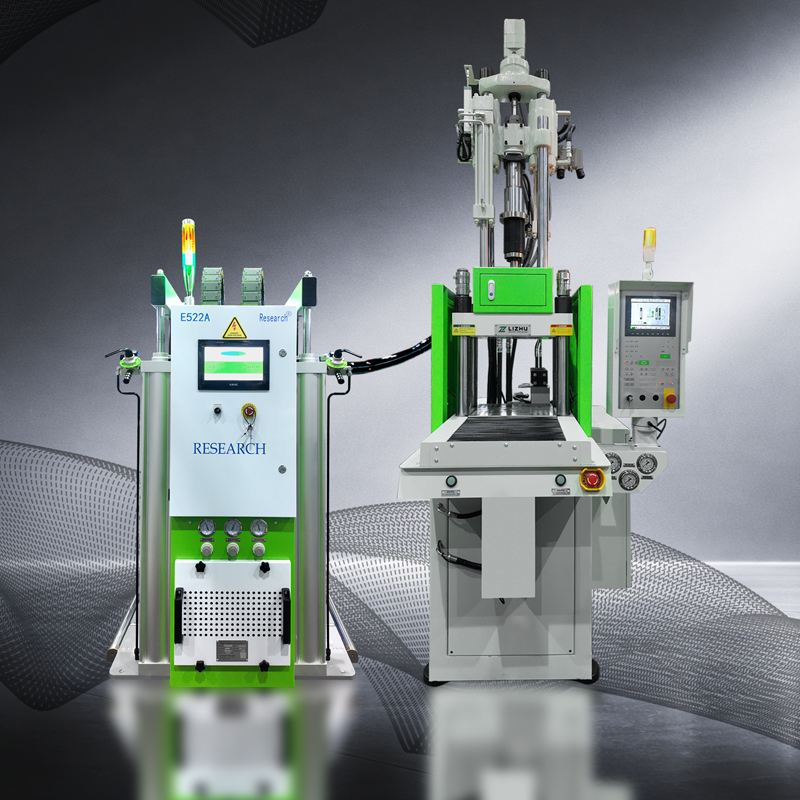
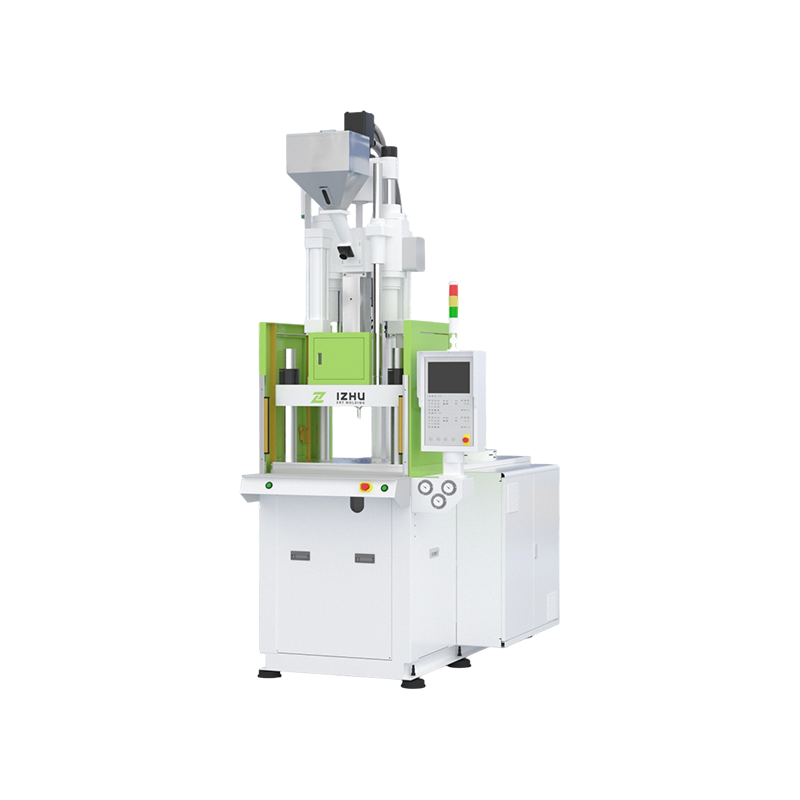
1. Vertical Clamp, Vertical Injection (Standard Vertical)
The most common configuration, this machine type has both the clamping unit and injection barrel oriented vertically on the same central axis. It is ideal for insert moulding of small to medium-sized parts with clamping forces typically ranging from 10 to 300 tonnes. The compact footprint — often as little as 1.2 m x 1.5 m — makes it highly suitable for crowded factory floors.
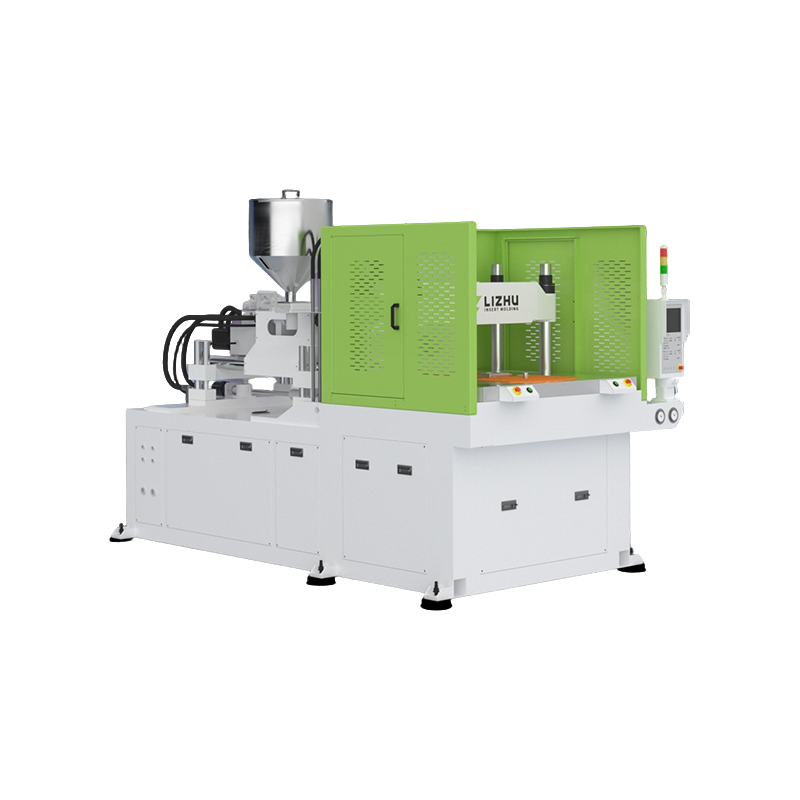
2. Rotary Table Vertical Moulding Machine
This configuration adds a rotating lower platen with two or more mould stations. While one station is under the injection unit being moulded, the operator loads inserts into the other station. This dramatically reduces cycle time — studies show rotary table machines can increase effective output by 30 to 50 percent compared to a fixed-table vertical machine of equivalent size. This type is widely used in automotive connector and cable moulding.
3. Vertical Clamp, Horizontal Injection (L-Type or C-Type)
In this hybrid configuration, the clamping unit is vertical but the injection unit is horizontal, forming an L or C shape. This design provides easy access to the mould from three sides and is preferred for moulding parts with complex runner systems or when the injection unit needs to be positioned away from the clamping axis to accommodate special mould designs.
4. Sliding Table Vertical Moulding Machine
Similar in purpose to the rotary table machine, this type uses a sliding lower platen that moves horizontally between two positions. One position sits under the injection unit for moulding; the other extends outward for operator access. This configuration provides superior ergonomics for loading large or complex inserts that would be difficult to position on a rotating platen.
Vertical vs. Horizontal Injection Moulding Machines: Key Differences
Vertical plastic moulding machines outperform horizontal machines for insert moulding and small-part production, while horizontal machines remain superior for high-volume, fully automated, large-part applications. The comparison below clarifies when each is the right tool for the job.
| Comparison Factor | Vertical Plastic Moulding Machine | Horizontal Injection Moulding Machine |
| Clamping Axis | Vertical (up-down) | Horizontal (side-to-side) |
| Floor Space Required | Up to 50% less | Larger footprint |
| Insert Moulding Capability | Excellent — gravity holds inserts | Limited — inserts must be retained mechanically |
| Operator Ergonomics | Waist-height mould access, low fatigue | Side access, can be awkward for inserts |
| Typical Clamping Force Range | 5 – 1,000+ tonnes | 10 – 10,000+ tonnes |
| Part Size Suitability | Small to medium parts | Small to very large parts |
| Automation Integration | Moderate — rotary/sliding tables assist | High — linear robots and conveyors standard |
| Multi-Component Moulding | Good with rotary table | Excellent with dedicated two-component machines |
| Typical Purchase Price (small units) | $15,000 – $120,000 | $20,000 – $200,000+ |
Table 1: Side-by-side comparison of vertical plastic moulding machines and horizontal injection moulding machines across key operational and commercial factors.
What Industries Use Vertical Plastic Moulding Machines
Vertical plastic moulding machines are used across a remarkably broad range of industries wherever metal-to-plastic bonding, overmoulding, or precision small-part production is required. The following sectors account for the majority of global vertical moulding machine deployments.
Automotive Components
The automotive industry is the single largest user of vertical plastic moulding machines. Applications include moulding plastic over metal terminals in wiring harness connectors, producing gear knobs over metal shafts, encapsulating sensors, and manufacturing dashboard switches. A single mid-size passenger vehicle contains over 1,500 individual plastic-over-metal insert-moulded components, the vast majority of which are produced on vertical machines.
Electronics and Electrical Engineering
Vertical plastic moulding machines are essential in electronics manufacturing for producing USB connectors, power plug bodies, coil bobbins, relay housings, and circuit breaker components. The ability to encapsulate delicate copper or brass terminals with precision tolerances of plus or minus 0.05 mm makes the vertical machine indispensable in this sector.
Medical Devices
In medical device manufacturing, vertical injection moulding machines produce syringe components, catheter connectors, surgical tool handles, and implantable device housings. Medical-grade vertical machines often incorporate cleanroom-compatible designs, servo-driven clamping for precise control, and full traceability systems to meet ISO 13485 and FDA requirements.
Consumer Goods and Hardware
Toothbrush handles, screwdriver grips, kitchen utensil handles, and padlock bodies are all classic applications for vertical plastic overmoulding machines. The ability to combine the structural strength of metal with the grip, colour, and comfort of plastic makes overmoulded consumer products premium items compared to all-plastic alternatives.
Telecommunications
RJ45 connectors, coaxial cable connectors, fibre-optic adapters, and SIM card housings are produced in enormous volumes using vertical plastic moulding machines. The combination of high speed, precise insert positioning, and consistent part quality makes vertical machines the backbone of telecom component manufacturing.
What Specifications Matter When Buying a Vertical Plastic Moulding Machine
When evaluating a vertical plastic moulding machine, clamping force, injection volume, platen size, and drive system type are the four specifications that most directly determine whether a machine suits your application. Here is what each means in practice:
| Specification | Typical Range | What It Determines | Selection Guidance |
| Clamping Force | 5 – 1,000+ tonnes | Maximum projected part area that can be moulded without flash | Calculate required force as: projected area (cm2) x material pressure factor (typically 0.3–0.5 tonnes/cm2) |
| Shot Volume / Weight | 5 g – 2,000+ g | Maximum amount of plastic injected per cycle | Target 70–85% of machine shot capacity for optimal plasticising consistency |
| Platen Size | 150 x 150 mm – 1,000 x 1,000 mm | Maximum mould size that can be mounted | Platen must be at least 20% larger than mould footprint on each side |
| Injection Pressure | 800 – 2,100 bar | Ability to fill thin-wall cavities and process high-viscosity resins | High-precision or thin-wall parts require machines capable of 1,600 bar or above |
| Drive System | Hydraulic / Electric / Hybrid | Energy consumption, speed, repeatability, and maintenance cost | All-electric saves 50–70% energy vs. hydraulic; hydraulic better for high clamping force at lower cost |
| Tie-Bar Spacing | 150 mm – 800 mm | Maximum width of mould that can be installed between the tie bars | Confirm mould width fits within tie-bar spacing before purchase |
| Screw L/D Ratio | 18:1 – 24:1 | Plasticising quality and melt homogeneity | Higher L/D improves melt quality; engineering resins typically require 22:1 or higher |
Table 2: Key technical specifications of vertical plastic moulding machines, their typical ranges, and practical selection guidance for buyers.
Why Vertical Plastic Moulding Machines Offer Unique Advantages
The vertical plastic moulding machine's combination of compact footprint, gravity-assisted insert retention, and ergonomic operation delivers economic and quality advantages that horizontal machines cannot replicate for insert-heavy applications.
Gravity-Assisted Insert Retention Reduces Defects
When inserts are placed into an upward-facing mould cavity, gravity holds them securely at the base of the cavity until the mould closes. This eliminates insert displacement — one of the most common defects in insert moulding. Industry data suggests insert displacement defect rates on vertical machines are typically 60 to 80 percent lower than on horizontal machines performing equivalent insert moulding tasks.
Factory Floor Space Saving of Up to 50 Percent
A vertical machine occupies floor area roughly equivalent to its platen size, with height making use of otherwise unused vertical space. A 50-tonne vertical machine might occupy just 1.5 m x 1.8 m of floor space, whereas a horizontal machine of equivalent clamping force typically requires 3 m x 2.5 m or more. For manufacturers paying commercial rates of $150 to $400 per square metre annually for factory floor space, this difference compounds significantly over the machine's 10 to 20 year service life.
Dual-Station Rotary Tables Maximise Productive Output
Rotary table vertical plastic moulding machines allow one operator to continuously load inserts while moulding proceeds, eliminating idle machine time between cycles. In practice, this can reduce the effective cycle time by 25 to 40 percent on insert-heavy parts compared to a fixed-platen vertical machine. For a part with a 20-second moulding cycle and 8-second insert loading time, a rotary table machine can run at the 20-second moulding cycle rate rather than the combined 28-second rate.
All-Electric Drive Systems Cut Energy Costs Dramatically
Modern all-electric vertical plastic injection moulding machines consume 50 to 70 percent less energy than equivalent hydraulic models because servo motors only draw power when the machine is actually moving. A 100-tonne hydraulic vertical machine may consume 15 to 22 kW continuously, while an all-electric equivalent consumes 5 to 8 kW average. At an industrial electricity rate of $0.12 per kWh operating 6,000 hours per year, the energy saving amounts to $7,200 to $10,800 annually per machine.
Superior Repeatability for High-Precision Applications
Servo-electric vertical moulding machines achieve shot weight repeatability of plus or minus 0.1 percent or better, compared to plus or minus 0.3 to 0.5 percent for conventional hydraulic machines. For medical or electronic components where dimensional tolerances of plus or minus 0.02 to 0.05 mm are required, this repeatability advantage directly reduces scrap rates and inspection costs.
How to Choose the Right Vertical Plastic Moulding Machine for Your Application
Selecting the correct vertical plastic moulding machine requires a structured evaluation of part complexity, production volume, available budget, and future scalability requirements. Follow this decision framework:
- Define your part geometry and insert complexity first. If your part requires precise placement of multiple metal inserts per cycle, a rotary-table or sliding-table vertical machine will reduce cycle time and defect rate far more effectively than a fixed-platen machine. If your part is a simple overmould with one insert, a standard fixed-platen vertical machine will suffice.
- Calculate the required clamping force with a safety margin. Determine the projected area of your part (including runners and sprues) in square centimetres. Multiply by the cavity pressure factor for your resin — typically 0.35 tonnes per cm2 for polyamide, 0.40 for ABS, and 0.45 for PC. Add a 15 to 20 percent safety margin. A part with 80 cm2 projected area in PA66 requires approximately 80 x 0.35 x 1.2 = 33.6 tonnes clamping force, so a 40-tonne machine is appropriate.
- Match the shot volume to the machine's plasticising capacity. The target is to use 70 to 85 percent of the machine's maximum shot weight per cycle. Operating below 30 percent causes excessive material residence time and degradation; operating above 90 percent risks incomplete fills.
- Consider the drive system based on volume and precision requirements. For high-volume precision applications — particularly medical and electronic components — all-electric vertical moulding machines offer superior repeatability and lower long-term operating costs despite a higher initial purchase price. For lower-volume, general-purpose insert moulding, hydraulic or hybrid machines offer a better initial investment-to-capability ratio.
- Evaluate automation compatibility. If your production plan includes future automation — vision systems for insert verification, robotic loading, or in-line quality inspection — confirm the machine's controller supports standard communication protocols such as OPC-UA or Euromap 67/77 interface standards.
- Factor in total cost of ownership, not just purchase price. A hydraulic vertical machine at $30,000 may cost $12,000 more per year to operate in energy and maintenance than an all-electric model at $55,000. Over a 10-year service life, the all-electric machine may be the more economical choice despite the $25,000 higher upfront cost.
Vertical Moulding Machine Drive System Comparison
| Drive Type | Energy Consumption | Repeatability | Purchase Cost | Maintenance Cost | Best Application |
| Hydraulic | High (baseline) | +/- 0.3 – 0.5% | Low | Medium (oil, seals) | General-purpose, high-force applications |
| All-Electric | 50–70% less than hydraulic | +/- 0.05 – 0.1% | High | Low (no hydraulic fluid) | Medical, electronics, precision parts |
| Hybrid | 30–50% less than hydraulic | +/- 0.1 – 0.2% | Medium | Medium | Mid-volume, mixed-material applications |
Table 3: Comparison of hydraulic, all-electric, and hybrid drive systems for vertical plastic moulding machines across energy, precision, cost, and application suitability.
FAQ: Vertical Plastic Moulding Machines
Conclusion: Is a Vertical Plastic Moulding Machine Right for Your Operation?
If your production involves insert moulding, overmoulding, or precision small-part manufacturing, a vertical plastic moulding machine is almost certainly the most efficient and cost-effective equipment choice available. Its gravity-assisted insert handling, compact footprint, ergonomic operator interface, and suitability for rotary-table automation give it decisive advantages over horizontal alternatives in these applications.
For manufacturers producing large flat parts in high volumes without inserts — such as automotive body panels, large containers, or furniture components — horizontal machines remain the appropriate technology. The key is matching the machine configuration to the specific demands of your part geometry, insert requirements, production volume, and quality standards.
The investment in the right vertical plastic moulding machine pays dividends across the entire production life of the part: lower defect rates, reduced floor space costs, better operator working conditions, and — with all-electric drive systems — significantly lower energy bills. Evaluate your requirements carefully against the specifications and configurations outlined in this guide, and consult with machine manufacturers for application-specific trials before finalising your purchase decision.
- Calculate required clamping force from projected part area and resin pressure factor
- Confirm shot volume target is 70–85% of machine maximum
- Verify platen size accommodates your mould with 20% clearance on each side
- Choose rotary or sliding table configuration if insert loading time exceeds 30% of mould cycle
- Select all-electric drive for medical, electronics, or high-volume precision applications
- Confirm OPC-UA or Euromap 77 controller interface if automation integration is planned
- Check CE, OSHA, or applicable regional safety certification
- Request resin-specific process trials before purchase commitment